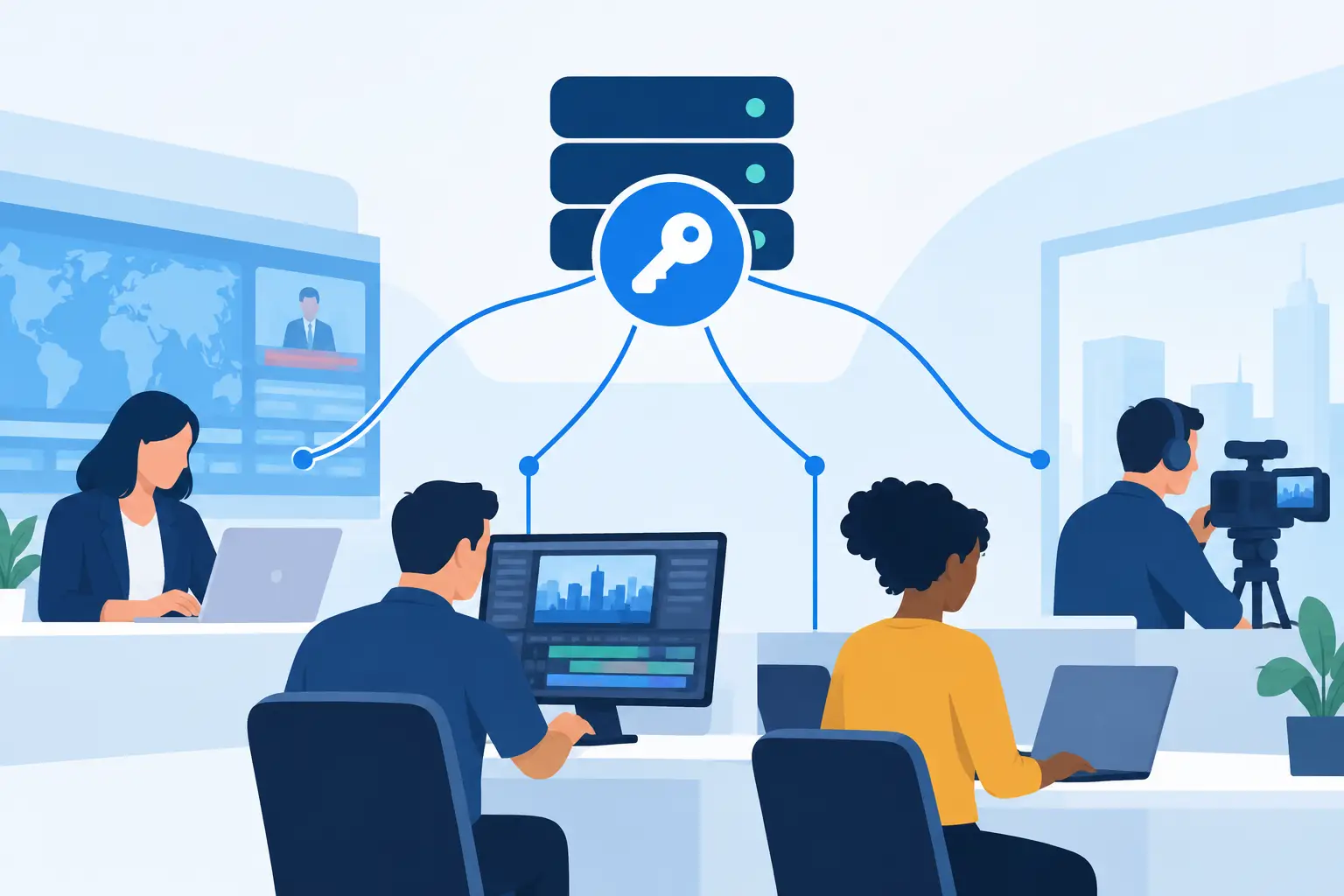
A headline package can move from a local control room to a national feed in minutes. The music underneath it may travel even farther: onto station sites, social clips, livestreams, podcasts, apps, affiliate feeds, and branded channels. That is why network license sharing cannot be treated as an informal production convenience. It is a rights question that needs an answer before the first bulletin goes to air.
For news organizations, the practical issue is simple: can multiple teams, outlets, or brands use the same licensed music without buying it again? Sometimes the answer is yes. Often, it depends on who purchased the license, which legal entities are covered, and how broadly the finished programming is distributed.
What network license sharing actually means
Network license sharing is the use of one music license across a connected group of channels, stations, programs, bureaus, or brands. A regional broadcaster may want one theme used by its flagship station and local affiliates. A digital publisher may operate several YouTube news channels under one parent company. A network may need the same breaking-news bed across television, radio, social video, and streaming.
Operationally, that makes sense. A consistent headline theme improves recognition, shortens edit decisions, and gives viewers the same sonic cue wherever they encounter the bulletin. Legally, however, a shared workflow does not automatically create shared usage rights.
The key distinction is between distributing a finished program and distributing the music asset itself. A properly licensed track may be cleared for use in a news package that airs worldwide. That does not necessarily mean every affiliated outlet has the right to download the master file, edit it into unrelated programming, or treat it as a pooled internal music library.
The questions that determine whether sharing is allowed
Before assigning a bed or stinger to a group-wide template, identify the license holder and the intended users. If one corporate entity owns all outlets and controls their production, licensing can be more straightforward. If affiliates are independently owned, operated under separate contracts, or produce their own programming, their use may require separate coverage.
Distribution scope matters as much as ownership. A track used on one local broadcast may need different permissions when the same segment is simulcast across a national network, uploaded to multiple channels, clipped for social media, or placed in a podcast archive. The production may be identical, but its reach is not.
Ask these questions before rollout:
- Is the license issued to the parent company, a single station, a production company, or an individual producer?
- Are all intended channels and brands part of the licensed organization?
- Does the license cover online, broadcast, or network distribution?
- Can affiliates create their own edits, or only air a centrally produced package?
- Will the music be used in recurring show opens, promos, social clips, podcasts, or third-party client work?
- Does the license remain valid after a producer, contractor, or partner leaves the organization?
These are not administrative details. They decide whether a music cue remains cleared when a newsroom scales a segment beyond its original assignment.
Why newsroom sharing creates avoidable risk
Fast-moving teams naturally build shared folders. A producer finds a useful economy bed, drops it into the morning rundown, and uploads it to a folder labeled “approved music.” Six months later, it appears in election coverage, sponsored explainers, a podcast trailer, and a sister station’s evening news open.
The problem is not that the team reused a track. Reuse is often exactly what a newsroom needs from a recurring sonic asset. The problem is that no one recorded the license scope when the file entered the system.
That gap can lead to unnecessary replacement work, takedown disputes, platform claims, or last-minute re-edits. It can also cause a subtler production issue: teams stop using the music because no one is confident it is cleared. A cue purchased to save time becomes a cue that sits unused while editors search for a safer option.
Clear rights records prevent this. Each shared music asset should have a short entry showing the track title, purchaser, license tier, purchase date, covered entities, approved uses, and any limits. Put that information where producers actually work, not in an inbox only the finance team can access.
Choose the license tier for the distribution you expect
Music licensing should follow the real route of the content, not the smallest version of the project. If a news video begins online but regularly moves to linear television, licensing only for a limited online use can create friction later. If a local station’s package is likely to enter a wider network feed, plan for that possibility before building it into a recurring format.
For independent digital news publishers, an online license may suit content distributed through a website, social platforms, and owned video channels. A broadcast license is intended for outlets producing for traditional on-air use. A network license is the practical choice when the music must support broad distribution across a network operation or multiple covered outlets.
The right tier is not always the largest tier. A single YouTube channel with no affiliate distribution does not need to pay for reach it will not use. But under-licensing a recurring headline theme is equally inefficient, especially when that theme becomes part of a larger rollout.
At Newsbed, licenses are structured as one-time Online, Broadcast, and Network options, so teams can match rights to distribution without subscription lock-in. The relevant point for any buyer is to select the tier that matches the outlet’s actual reach and to confirm coverage before sharing music beyond the original production unit.
Build a controlled sharing workflow
A good shared-music workflow should be fast enough for breaking news. It does not need a complicated rights-management system. It needs a clear source of truth and a few production rules that everyone understands.
Start with one approved library for active use. Do not let licensed files circulate through personal drives, chat attachments, or unnamed desktop folders. Use clear labels such as “Online cleared,” “Broadcast cleared,” or “Network cleared,” and include the license record alongside the production files.
Then separate music files from editable project templates. A producer may be able to open a shared After Effects or Premiere project without automatically receiving permission to reuse every track embedded in it. The template should identify the approved cue and the license scope, particularly when outside editors, freelancers, or affiliate teams receive a copy.
Finally, give one person or small team responsibility for questions that do not fit the standard rules. This is not about slowing down editorial production. It is about avoiding the familiar 10-minute scramble before air when a producer asks whether a stinger is cleared for the network feed.
Consistency has value, but it needs boundaries
Sharing a headline bed across a newsroom group can be a strong editorial decision. Viewers recognize the format. Editors can cut to known bulletin timings. Anchors benefit from dialogue-friendly underscore versions that support the script rather than compete with it. Producers can move quickly when the package includes :60, :45, :30, :15, and stinger cuts built for real rundowns.
Still, consistency should not turn into uncontrolled access. A network-level theme may be appropriate for groupwide breaking coverage, while a local station’s sponsor-supported feature series may need its own licensing review. A cue cleared for news programming may not be appropriate for advertising, entertainment programming, or client productions outside that scope.
The best approach is practical: share music where the license expressly supports shared use, keep the usage tied to the covered organization and programming, and document exceptions before the asset becomes part of the daily workflow.
When a track is meant to carry a story across multiple newsrooms, treat its rights with the same care as the story feed itself. The clearer the license path is at the start, the faster your teams can cut, publish, and air with confidence.